Masticating vs Centrifugal Juicer: Which One Is Right for You?
Masticating juicers use a slow-turning auger to crush and press produce, which preserves more nutrients and handles leafy greens well. Centrifugal juicers spin a shredding disc at high speed to extract juice in seconds, making them faster and cheaper but less effective on soft greens. Your choice comes down to what you juice most, how much prep time you have, and what you want to spend.

How Each Type Works
A masticating juicer (also called a slow or cold-press juicer) rotates an auger at roughly 40 to 80 RPM to grind produce against a fine screen. The low speed generates very little heat, which is why manufacturers and juicing enthusiasts credit it with better enzyme and nutrient retention. A centrifugal juicer instead uses a fast-spinning mesh basket, typically 6,000 to 16,000 RPM, to shred produce and fling the juice outward through small holes. The two machines share almost no mechanical DNA, which is why they differ so much in speed, noise, price, and what produce they handle well.
Juice Quality and Yield
Masticating juicers generally produce drier pulp, meaning more liquid ends up in your glass. The slow pressing action is particularly effective on leafy greens such as kale, spinach, and wheatgrass, which a centrifugal machine tends to pass through without fully extracting. Centrifugal juicers do a solid job on firm produce like apples, beets, and carrots, where the shredding speed is actually an advantage. The trade-off is that the high-speed process introduces some air and heat, which can accelerate oxidation. Most centrifugal juice tastes best consumed right away, while cold-press juice is commonly said to keep in the fridge for 24 to 72 hours with minimal quality loss.
Speed, Noise, and Convenience
Centrifugal juicers are fast: most process a full glass of apple or carrot juice in under a minute. Masticating juicers are slower by design, and depending on the produce and the machine, juicing can take two to four times as long. Noise is a real difference too. The high RPM of a centrifugal motor produces a loud grinding whine, while most masticating juicers run quietly enough to hold a conversation nearby. On the prep side, many centrifugal models have wider feed chutes, so you can drop in a whole apple or a large carrot without pre-cutting. Masticating juicers typically require smaller, more uniform pieces to avoid jamming the auger.
Price and What You Get at Each Level
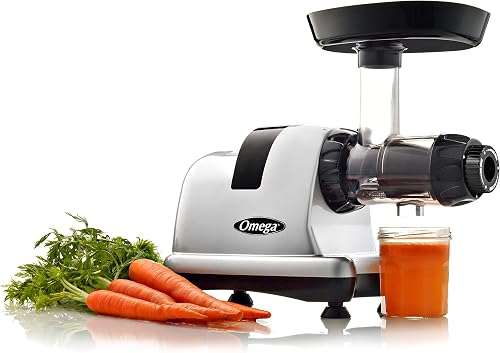
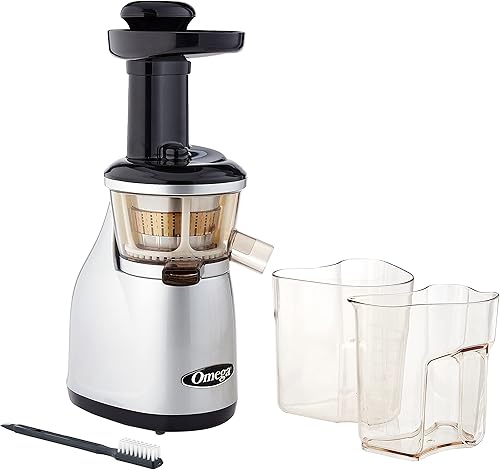
Centrifugal juicers are the more affordable entry point, with many solid options under $100. Masticating juicers start higher: the Omega J8007S, rated 4.5 out of 5 stars across 410 reviews, runs $199.87 and draws 200 W through a stainless steel auger system weighing 14.3 lb. The Omega VRT350 is in the same price range at $199.87, pulls 150 W, and has earned 4.3 stars from 1,500 reviewers, making it one of the more proven slow juicers in this tier. At the budget end of masticating, the Elite Gourmet EJX600 costs $42.99 and carries 3.9 stars from over 5,300 reviews, giving a lower entry cost for shoppers who want to try cold-press juicing without a large commitment. Premium masticating models from Kuvings and Tribest can push past $300 to $700, with wider chutes and heavier build quality.
Cleaning and Maintenance
Centrifugal juicers often win on cleanup speed. Most have a mesh basket and two or three other removable parts that rinse in about a minute. Masticating juicers have more components, including the auger, screen, end cap, and juice bowl, and the fine screen requires attention with a small brush to clear fibrous pulp from the mesh. Expect five to ten minutes of cleaning for a slow juicer versus one to three minutes for a centrifugal model. If cleaning time is a genuine barrier to juicing daily, that matters more than theoretical nutrient differences.
Which Type Fits Your Situation
Choose a masticating juicer if you prioritize leafy greens, wheatgrass, or nut milks, want to store juice overnight, or value quiet operation. Choose a centrifugal juicer if speed and price are the priority, you mostly juice hard fruits and vegetables, and you drink juice immediately after making it. Families who juice in batches a few times per week tend to find the slow juicer's yield advantage worthwhile over time. Individuals who want a quick glass before work on busy mornings often find centrifugal more practical regardless of the nutrient debate.
Common mistakes to avoid
- Buying a masticating juicer expecting zero cleanup, then abandoning it because the screen takes several minutes to scrub.
- Judging centrifugal juice as inferior without considering that firm produce like carrots and beets yields well in a fast spinner.
- Overloading a masticating juicer with large chunks, which jams the auger and strains the motor.
- Storing centrifugal juice overnight and expecting the same quality as fresh, since oxidation from the high-speed process speeds up flavor loss.
- Choosing a wide-chute centrifugal model and assuming it handles wheatgrass or soft herbs, which it handles poorly compared to a slow juicer.
- Ignoring wattage when comparing masticating models: a 100 W motor like the Elite Gourmet EJX600 will bog down on dense beets or frozen produce that a 200 W motor handles without stopping.
Frequently asked questions
Is masticating juice actually more nutritious than centrifugal juice?
The slow-press process generates less heat and air contact, which is believed to slow oxidation and preserve heat-sensitive enzymes. That said, both types deliver a nutrient-dense drink compared to not juicing at all. The practical difference matters most if you store juice for more than a few hours, where cold-press holds up better.
Can a masticating juicer handle hard vegetables like beets and carrots?
Yes, most masticating juicers handle beets and carrots well when the produce is cut into small pieces. Models with higher wattage, such as the 200 W Omega J8007S, manage dense root vegetables more reliably than entry-level 100 W motors. Cut pieces to roughly one inch to avoid straining the auger.
How long does masticating juice last in the refrigerator?
Cold-press juice stored in a sealed, airtight container generally keeps for 24 to 72 hours in the refrigerator before flavor and nutritional quality noticeably decline. Centrifugal juice is best consumed the same day because the higher oxidation rate from the fast-spinning process accelerates separation and flavor loss.
Are masticating juicers worth the extra cost for beginners?
It depends on what you plan to juice. If you want to juice primarily leafy greens or plan to prep juice in batches to store, a masticating juicer pays off in better yield and longer shelf life. If you are new to juicing and want to try it with hard fruits and vegetables at low cost, starting with a centrifugal juicer is a sensible, lower-risk first step.
What produce does a centrifugal juicer not handle well?
Centrifugal juicers struggle with leafy greens like spinach, kale, and wheatgrass because the high-speed disc cannot compress soft plant material effectively. The yield from greens is low and the pulp comes out wet, meaning you lose a significant portion of the juice. Soft herbs and pine needles present the same problem.