Are Personal Blenders Good for Smoothies?
Yes, personal blenders are genuinely good for smoothies, especially single-serving ones you drink straight from the cup. They blend soft fruit, yogurt, protein powder, and most frozen fruit without trouble, and the single-serve cup means one less thing to wash. Where they fall short is with very fibrous greens like raw kale stems, large ice chunks, or nut butters in bulk, situations where a full-size countertop blender has a clear edge.


How Wattage Affects Smoothie Quality
Wattage is the single biggest factor in how smooth your smoothie turns out. Models under 300 watts, like the CULINARY CHEF CCSMM1OOPINK at 300 W or the DASH DMB100GBAQ06 at 150 W, handle soft fruit, milk, and protein powder cleanly, but they will leave small chunks when you add frozen berries or fibrous spinach. A step up to the NutriBullet ZNB30100Z at 1000 W means frozen fruit breaks down fast and consistently, which is why it holds a 4.6-star rating across nearly 4,800 reviews. The NutriBullet N12-1001MK at 1200 W goes further, giving you enough power to handle dense greens and ice together in the same blend, and it has earned a 4.5-star rating from over 11,700 buyers. Higher wattage also means the motor runs less time to reach the same result, which reduces heat buildup and can preserve more of the texture of delicate ingredients.
Jar Size and the Single-Serving Trade-Off
Most personal blenders ship with a 16 oz or similar cup that doubles as a travel bottle. That size is right for one smoothie, but it limits what else you can do. The Magic Bullet MBPB50100AK, for example, uses a 16 oz plastic jar and weighs under 2 lb, making it easy to store and carry. If you routinely blend for two people or want to prep a larger batch, you will hit the capacity ceiling quickly and need to blend in two rounds. The Ninja CL401A is a notable outlier with a 71 oz jar, which is closer to a personal blender-countertop hybrid, useful if volume matters to you. For a daily single-serving smoothie routine, the standard 16 oz cup is enough, but it is worth checking the jar size listed in the specs before you order.
What Ingredients Work Best
Soft or pre-thawed frozen fruit, Greek yogurt, nut milk, protein powder, oats, and baby spinach all blend smoothly in even a mid-range personal blender. Frozen fruit straight from the freezer works well at 900 watts and above. Fibrous stems, like raw kale stalks or celery, can wrap around the blade and stress lower-wattage motors, so trim them or give lower-power models a break halfway through. Ice cubes are manageable at 1000 watts, but if your recipe is mostly ice you may get better results with crushed ice rather than whole cubes. Seeds like flax and chia blend fine because they are small, while whole nuts are better pre-soaked or ground before adding.
Noise, Cleanup, and Daily Usability
Personal blenders are louder per-ounce than you might expect because the motor is small and works harder relative to its size. Most run 20 to 40 seconds for a typical smoothie, so the noise is brief. Cleanup is straightforward: rinse the cup immediately after use, add a drop of dish soap and a bit of water, run it for a few seconds, then rinse again. Most cups and lids are top-rack dishwasher safe, though checking the manual for your specific model is worth doing because blade assemblies vary. The compact footprint, typically 3 to 5 inches wide, means a personal blender fits on the counter without taking up meaningful space, which makes it realistic to leave it out and actually use it every morning.
When a Personal Blender Is Not the Right Tool
If you blend for a family, make soups or sauces in large batches, or frequently use whole frozen vegetables like cauliflower, a countertop blender will serve you better. Personal blenders also struggle with very thick nut butters and dense frozen smoothie packs that require significant torque. The small jar means multiple batches for anything above one serving, which defeats the convenience advantage. For something like a green smoothie with stems, raw beets, or large chunks of frozen mango, the power ceiling of most personal blenders becomes noticeable. That said, for a single daily fruit-and-protein smoothie, the trade-offs are minor and most people find the convenience outweighs the limitations.
Choosing a Personal Blender for Smoothies
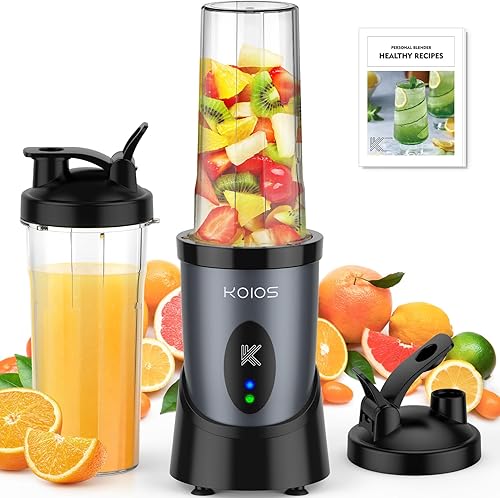
Match the motor to what you actually blend. If your smoothies are mostly fresh or pre-thawed fruit with liquid and powder, 150 to 300 watts is enough. If you blend frozen fruit regularly, aim for 900 watts or more. The KOIOS personal blender at $29.99 has a 4.4-star rating from nearly 4,000 reviewers and moves over 900 units a month, which makes it one of the more validated budget picks. For buyers who want more consistent power without going over $80, the NutriBullet ZNB30100Z at $75.87 and 1000 W is a well-reviewed step up. If you want the most headroom for dense blends, the NutriBullet N12-1001MK at $111.05 and 1200 W is the highest-rated option in the category with the largest review base.
Common mistakes to avoid
- Buying on price alone and ending up with a 150 W motor that stalls on frozen fruit.
- Overfilling the cup past the max-fill line, which can force liquid up into the motor base.
- Adding whole ice cubes to a low-wattage blender instead of using crushed ice.
- Letting fibrous kale stems or celery strings wrap around the blade instead of trimming them first.
- Skipping the quick rinse right after blending, which lets protein powder or dairy crust onto the blade assembly.
- Assuming all personal blender cups are dishwasher safe on the bottom rack without checking the manual.
Frequently asked questions
Can a personal blender crush ice for smoothies?
A personal blender rated at 900 watts or more can handle a few ice cubes mixed with liquid and fruit without straining. Below that threshold, whole ice cubes can stall the motor or leave visible ice shards in the final drink. Using crushed ice instead of cubes reduces the load on any motor, so that is a reliable workaround if your blender is in the 150 to 300 watt range.
How long does a personal blender last with daily smoothie use?
Daily use puts real wear on a personal blender motor, and most entry-level models are built for light use rather than continuous daily work. Higher-wattage models with stainless steel components tend to hold up longer than budget plastic options. Cleaning the blade assembly thoroughly after each use, and not running the motor for more than 60 seconds at a stretch, extends the life of any model.
Is a personal blender powerful enough for green smoothies?
Baby spinach and pre-washed spring greens blend well in even a mid-range personal blender because the leaves are soft and small. Mature kale, Swiss chard with thick ribs, or raw beet greens need more power, generally 900 watts or above, to fully break down without leaving fibrous bits. Removing tough stems before blending makes a real difference regardless of wattage.
Can I use a personal blender for protein shakes?
Yes, personal blenders are well suited to protein shakes. Powder dissolves cleanly in liquid and the motor does not need to work hard, so even a 150 W model handles it without issue. Adding frozen fruit or oats to the shake makes the job a bit harder, but anything at 300 watts or above manages it comfortably.
What is the difference between a personal blender and a regular blender for smoothies?
A countertop blender has a larger jar, a higher-wattage motor, and more capacity for batch blending, but it requires you to pour your smoothie into a separate cup afterward. A personal blender blends directly in the drinking cup, which means less cleanup and more convenience for one serving. The trade-off is capacity and peak power, so if your smoothies are single-serving and not full of whole frozen produce, a personal blender covers the job just as well.