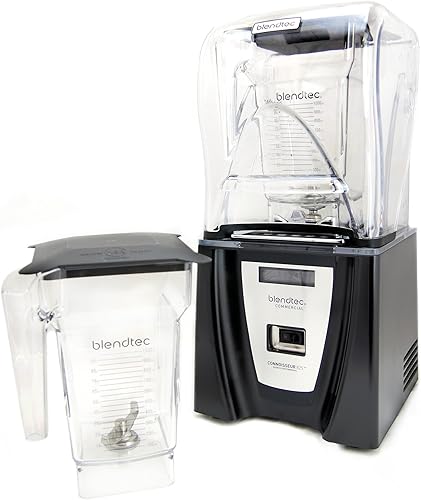
A commercial-leaning Blendtec with a metal jar and alloy steel blades built for heavy daily use. At $1,141.77 it is a significant investment that makes sense mainly for high-volume settings.
High-volume commercial or prosumer kitchens that need a metal-construction blender and have the budget for it.
Skip if
You are outfitting a home kitchen or working with a tight budget. The price far exceeds most home blending needs.
Power 120 W
Jar / bowl material Metal
Blade material Alloy Steel
Controls Push Button
Color Black
Dimensions 9 X 9 X 18.7 In
Priced 339% above the category median ($259.87 across 127 tracked models)
Power of 120 W - lower than 99% of the 134 models we track
Pros
Metal jar adds durability for high-volume use
Alloy steel blades handle tough ingredients
Simple push-button operation
4.3-star average across 77 reviews reflects solid owner satisfaction
Commercial-grade construction in a relatively compact footprint
Cons
Price of $1,141.77 is hard to justify for home kitchens
Only 77 reviews means long-term reliability data is limited
No variable speed or speed count listed
Our scorecard
4.2/5overall
Owner rating4.3/5
4.3 average across 77 owner ratings
Popularity1.5/5
77 owner reviews, fewer than most models here
The overall score is owner satisfaction weighted by how many reviews back it, so a high rating from few reviews counts for less. The bars below show where this model stands against the other countertop and personal blenders, immersion blenders, food processors, and masticating, centrifugal and citrus juicers we track in this category on price, popularity and size. Context, not marks against it, and our read of the data, not a lab test.
Specifications
Power
120 W
Jar / bowl material
Metal
Blade material
Alloy Steel
Controls
Push Button
Color
Black
Dimensions
9 X 9 X 18.7 In
Voltage
120 Volts
Overview
The Blendtec c825c11q-b1gb1a is a workhorse machine with a metal jar and alloy steel blades, a combination designed to handle the kind of volume you see in a juice bar or commercial prep environment. Push-button controls keep operation simple, and the 9 x 9 x 18.7 in footprint fits most commercial counter configurations.
With 77 buyer reviews landing at 4.3 stars, the reception leans positive. Buyers tend to appreciate the build quality and durability over the long term, which matters when the price tag clears $1,100.
That price is the main conversation starter. For home use, there are capable options at a fraction of the cost. This machine earns its keep when reliability and build robustness over thousands of cycles outweigh upfront cost.
Performance notes
The metal jar and alloy steel blade assembly are the defining performance factors here. Metal jars resist cracking under thermal and impact stress better than plastic alternatives. The push-button control format keeps the interface minimal, which can actually reduce operator error in a busy environment. Dimensions of 9 x 9 x 18.7 in indicate a taller profile suited to counters with overhead clearance.
What buyers say
With 77 reviews averaging 4.3 stars, buyer feedback is cautiously positive. The modest review count means the sample is smaller than ideal for drawing firm conclusions, but the above-average rating suggests owners who do commit to this machine generally find it delivers on durability expectations.
Is the Blendtec c825c11q-b1gb1a suitable for a home kitchen?
It can physically sit in a home kitchen, but the $1,141.77 price is hard to justify for typical home use. Most home cooks will find comparable blending results from machines costing $300 to $600. This model is better matched to commercial or prosumer users who cycle through heavy loads daily.
What makes the metal jar different from a plastic jar?
Metal jars are more resistant to cracking, staining, and odor absorption than plastic alternatives. They also hold up better under repeated high-stress blending cycles. The tradeoff is that you cannot see the contents while blending, which matters if you are working with precise fill levels.
How does alloy steel differ from stainless steel blades?
Alloy steel blades are engineered for hardness and edge retention under impact, making them well suited to blending ice and hard frozen ingredients at high volume. Stainless steel blades are more corrosion-resistant. Both are food-safe, but alloy steel blades in this context suggest a performance-first design priority.
We use necessary cookies to keep the site working. With your permission, we also use functional, analytics, and marketing cookies. Read our Cookie Policy.