How to Choose a Citrus Juicer
The right citrus juicer comes down to three things: how often you juice, what size fruit you use, and how much cleanup you are willing to do. A compact 40-watt model like the Elite Gourmet ETS740 (rated 4.4 stars across 4,488 reviews at $16.12) handles daily orange juice without taking up counter space. If you juice larger volumes or tougher fruits like grapefruits, a machine with more motor power and a larger juice bowl makes the job noticeably easier.


Manual vs. Electric: Which Type Fits Your Routine
Manual citrus juicers have no motor, no cord, and nothing to break. You press or twist the fruit by hand, which works fine for a lime wedge or a quick lemon squeeze. For anything beyond two or three pieces of fruit, the hand effort adds up. Electric models take over the pressing work automatically. A reamer spins when you press fruit down, which means consistent extraction without fatiguing your wrist. If you make fresh juice three or more mornings a week, an electric juicer pays for itself in convenience quickly. The price gap between basic electric models and manual ones is small, often under $20.
Motor Power and What It Actually Affects
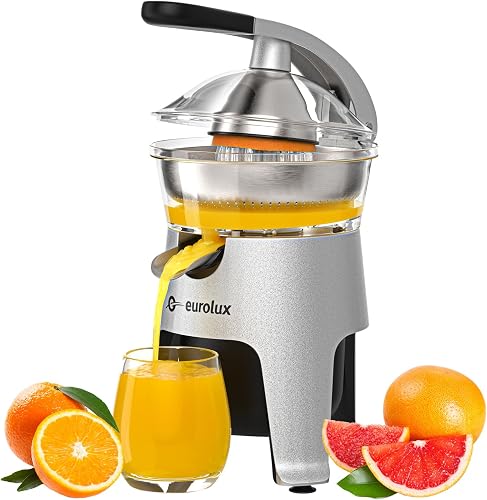
Most home citrus juicers run between 40 and 160 watts. The Dominion DCJ240 runs at 40 watts and still earns a 4.5-star rating from 155 buyers at $16.99, which shows that raw wattage is not the whole story for soft citrus like oranges and lemons. Higher wattage helps most with denser fruit skins, grapefruits, and high-volume use. The Eurolux DEYS-JS-1127-093 runs at 300 watts and comes with a die-cast body, putting it in a different category from compact home models at $159.99. For everyday home use, 40 to 160 watts is the practical range to shop in.
Reamer Size and Fruit Compatibility
Most electric citrus juicers include either a single universal reamer or two interchangeable reamers in different sizes. A small reamer fits limes and small lemons. A medium reamer covers navel oranges and most lemons. A large reamer handles grapefruits and blood oranges without splitting the fruit unevenly. Some models include only one reamer, so check the listing before you buy if grapefruits are part of your regular routine. Using the wrong reamer size pushes pulp and seeds into the juice bowl and leaves a lot of juice in the rind.
Juice Bowl Capacity and Pulp Control
The juice bowl sits under the reamer and collects everything that drips through. Capacity ranges from around 17 ounces on compact models up to 40 ounces or more on larger ones. The Boss 8962 holds 40 ounces at a 150-watt motor and costs $28.12 with a 4.2-star rating from 509 reviewers, which suits households that juice a full bag of oranges at once. Smaller bowls mean more trips to pour and return. Pulp control, when present, is usually a strainer or a filter with adjustable openings. If some people in your household want pulp-free juice and others do not, look for a model with a removable strainer rather than a fixed screen.
Materials, Build Quality, and Cleanup
Plastic juice bowls and bodies are lighter and cheaper, but they stain over time and can hold citrus odors if not rinsed promptly. Stainless steel parts resist staining and are easier to wipe down. The Elite Gourmet ETS623 uses stainless steel construction and earns a 4.5-star rating from 6,897 reviewers at $13.99, which is strong evidence that durable materials do not have to cost more. Dishwasher-safe removable parts cut cleanup from several minutes to seconds. Before you buy, check which parts detach and whether they are listed as dishwasher safe. The reamer cone and the juice bowl are the two pieces that matter most.
Countertop Footprint and Storage
Citrus juicers are among the smaller kitchen appliances, but size still varies enough to matter in a tight kitchen. The Luukmonde D-8020A measures 6.3 by 7.87 by 9.06 inches and weighs 2.2 pounds, light enough to store in a cabinet and pull out daily without friction. Heavier commercial-grade models like the Waring BJ120C weigh 6.1 pounds and measure 7.25 by 7.25 by 9.25 inches, which suits a dedicated counter spot rather than a cabinet shelf. If you have limited counter space, prioritize compact dimensions and a cord that wraps or stores neatly.
Common mistakes to avoid
- Buying a reamer that only fits one fruit size when you regularly juice both limes and grapefruits
- Choosing a model with a non-removable juice bowl, which makes pouring awkward and cleanup slow
- Overlooking the strainer design and ending up with more seeds in the glass than expected
- Buying based on wattage alone rather than checking actual capacity and reamer size for your fruit
- Picking a very cheap manual juicer for high-volume use and burning out your wrist after the first week
- Ignoring weight when buying for a cabinet-storage setup, then leaving the juicer on the counter permanently because it is too heavy to move
Frequently asked questions
Do I need more than 40 watts for home citrus juicing?
For soft citrus like oranges, lemons, and limes, 40 watts is enough. The Elite Gourmet ETS623 at 40 watts holds a 4.5-star rating from nearly 7,000 reviewers, which reflects real-world satisfaction at that power level. You only need significantly more wattage if you juice grapefruits daily, process large quantities in one session, or use fruit that is cold from the refrigerator, which makes the pulp stiffer.
What is the difference between a citrus juicer and a masticating juicer for citrus?
A citrus juicer uses a spinning reamer designed specifically for halved citrus fruit. It is faster, easier to clean, and costs far less than a masticating juicer. Masticating juicers can handle citrus but are designed for a wider range of produce including leafy greens and hard vegetables. If you juice only citrus, a dedicated citrus juicer is the simpler and more practical tool.
How important is a pulp control feature?
It matters if people in your household disagree on pulp. Without pulp control, you get whatever the strainer lets through, which is usually medium pulp. A model with an adjustable or removable strainer gives you the option to go pulp-free for one glass and leave it in for the next. If everyone in the house drinks the same style, a fixed strainer is fine and simplifies the design.
Are stainless steel citrus juicers worth the extra cost?
Not always. The Elite Gourmet ETS623 uses stainless steel construction and costs $13.99, which is cheaper than many plastic alternatives. The real benefit of stainless steel is that it does not absorb citrus odors or stain yellow over months of use. For a machine you will use daily and store on the counter, stainless is worth looking for even at the budget end of the market.
How do I know if a citrus juicer will fit my kitchen cabinet?
Check the listed dimensions on the product page, specifically the height when fully assembled. Most compact models stand under 10 inches tall. The Luukmonde D-8020A, for example, is 9.06 inches tall and weighs 2.2 pounds, easy to slide in and out of a standard cabinet. Compare that height to your cabinet clearance before ordering to avoid a return.